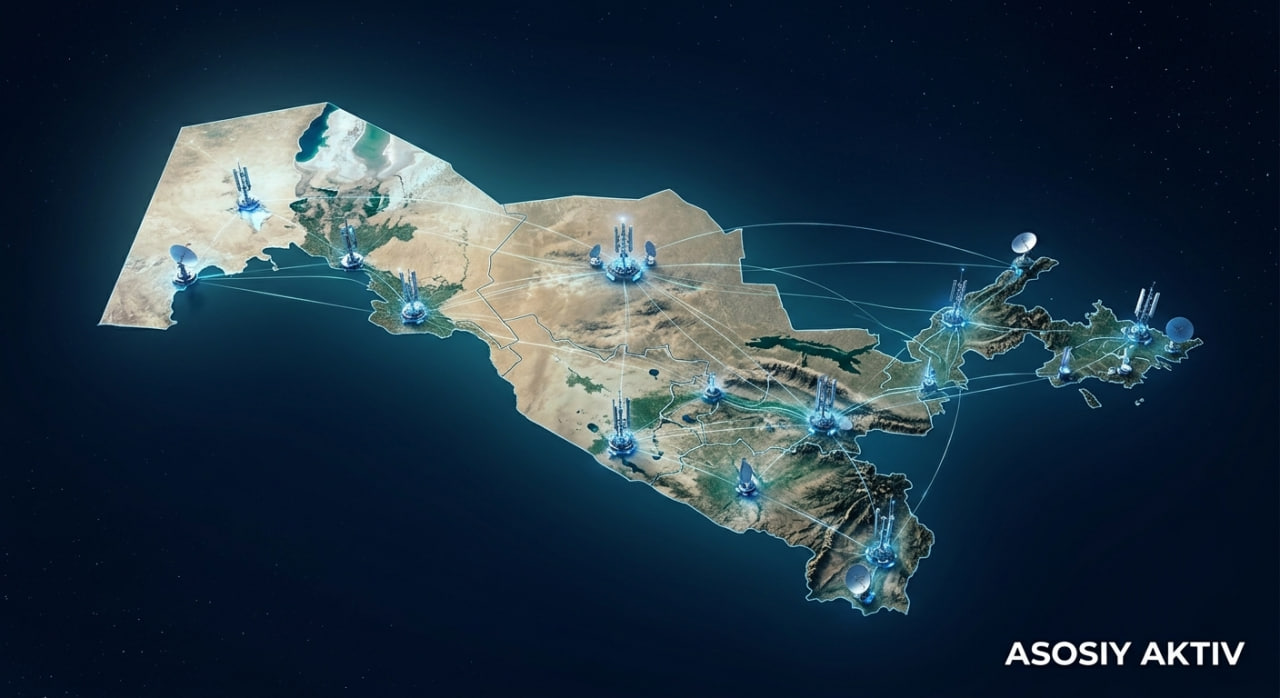
The government's "Uzbekistan 2030" strategy, aimed at transforming the country into a regional IT hub, demands the immediate modernization of all backbone networks. With the state and corporate sectors tasked with increasing internet speeds 10-fold and achieving 100% fiber-optic coverage, the heavy burden of capital expenditures (CAPEX) and revenue asymmetry are actively fueling conflicts within the financial market.
Revenue Architecture and the ARPU Discrepancy
According to the analytical agency Nexign, more than half of the sector's revenue—51%—is generated directly by internet access services. Mobile communication accounts for 27.7%, while international and long-distance telephony has plummeted to a mere 8.5%, confirming the deepening crisis of traditional voice services. Another 7.9% of revenue is derived exclusively from data transmission networks.
The sharpest financial conflict has manifested in Average Revenue Per User (ARPU) metrics. Between 2020 and 2024, the ARPU for mobile internet users steadily climbed at an average annual rate of 21.2%. Conversely, in fixed broadband (BBA) networks, this indicator collapsed by 6.73% every single year.
The 83% Monopoly and Infrastructure Siege
This financial anomaly in the market is directly linked to an institutional monopoly. 83% of the home internet and fixed-line segment operates under the control of a single state enterprise—Uzbektelecom. Persistent price dumping and the artificial suppression of ARPU in broadband networks have virtually eradicated the investment appeal of wired infrastructure for private operators.
Consequently, a severe asymmetry has emerged in the market. While the country's cellular subscriber base has surged to 36.3 million people (a 96.6% penetration rate), the wired internet user base remains stagnant at just 2.93 million. The majority of large-scale infrastructure projects are executed exclusively by one player with direct state backing.
5G FWA and Corporate Diversification
In response to the cable monopoly, private mobile operators have aggressively pivoted capital toward 5G networks and FWA (Fixed Wireless Access) technologies. The fact that a large portion of Uzbekistan's population resides in rural areas with predominantly flat terrain allows the rapid deployment of 5G FWA to bypass Uzbektelecom's infrastructure bottleneck. Successful 5G tests in Tashkent's technological zones and business clusters have now transitioned into mass commercial operations across high-load areas.
Amid shrinking margins from traditional traffic, market players are forced into urgent revenue diversification. In the retail sector, operators are abandoning basic communication services to capture the super-app, fintech, and streaming markets. In the corporate B2B segment, the cost of services is being artificially inflated through the implementation of cloud systems, closed VPN networks, and artificial intelligence (AI) platforms.
Sustaining an average annual growth rate of 12.1%, the total market volume is projected to reach 35.02 trillion UZS ($2.91 billion) by 2028. The collision between a state monopoly unilaterally controlling the backbone infrastructure and private capital pouring billions into technological transformation will inevitably push the mobile tariff price war into an entirely new, ruthless phase.