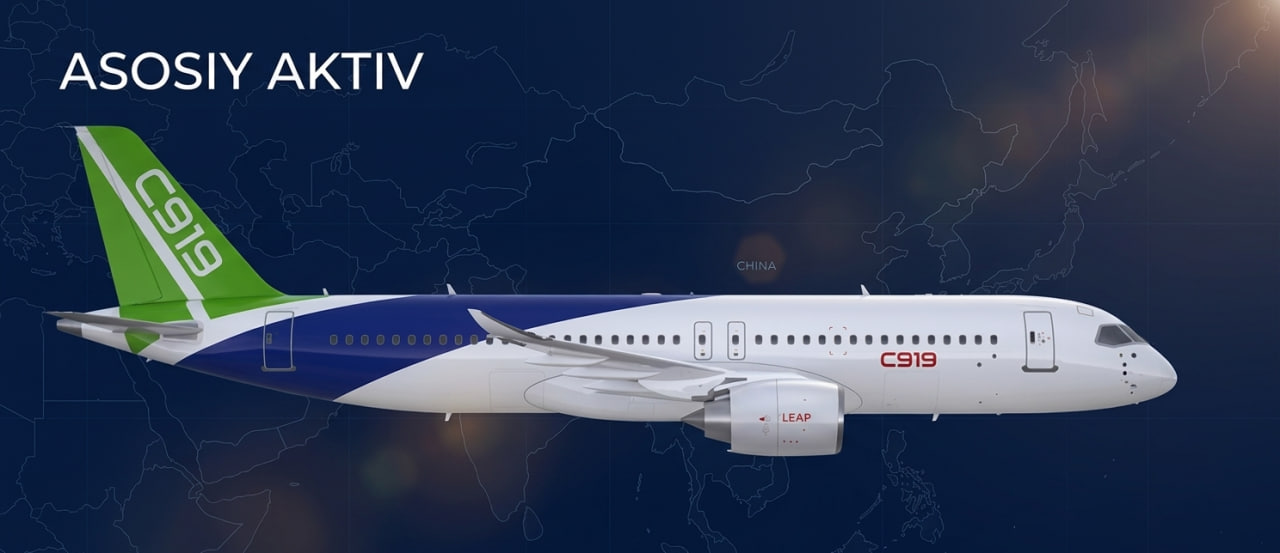
As China's Comac C919 passenger jet executes its inaugural international commercial flight from Beijing to Ulaanbaatar, more than half of the supply chain anchoring this project of national pride remains strictly beholden to U.S. corporations. Positioned as a direct challenger to the Boeing 737 and Airbus A320, the narrow-body airliner is fundamentally an assembled matrix of Western aerospace technologies.
The two-hour flight operated by Air China is being broadcast as a geopolitical signal intended to disrupt the entrenched Boeing-Airbus global duopoly. In reality, the deployment masks a severe production crisis and highlights a fragile industrial experiment entirely dependent on a U.S.-China trade truce expiring in November. Lacking validation from Western regulators, the aircraft is entering international airspace driven by political mandate rather than technical maturity.
The Supply Chain Illusion
Analysis conducted by the Center for Strategic and International Studies (CSIS) reveals that, as of 2020, over half of the suppliers for the C919 were located in the United States. Scott Kennedy, a senior adviser at CSIS, asserts that branding the heavily delayed aircraft as Chinese is misleading due to its reliance on imported components, noting it remains less efficient than its Western counterparts.
The direct consequence of this technological dependency is a collapse in production output. Last year, the state-owned Comac (Commercial Aircraft Corporation of China) managed to deliver a mere 15 units to customers, drastically missing its target of 75. Brookings Institution fellow Kyle Chan emphasizes that unlike China's rapid dominance in electric vehicles (EVs), aviation demands the complex integration of precision electro-mechanical control systems and the orchestration of a vast global supply chain.
Geopolitical Bartering
The vulnerability of the program became critically exposed last year when Washington suspended the export of specific components to Comac amid escalating trade hostilities. During Donald Trump's state visit to Beijing in May, the Chinese government was forced into a strategic concession: securing U.S. supply guarantees for essential engine parts by agreeing to a massive procurement of 200 Boeing jets.
This maneuver substantiates warnings from Zhang Yanzhong, an academic at the Chinese Academy of Engineering, who stated that relying on foreign entities for large aircraft technology actively threatens China's national strategic security. Western suppliers maintain a stranglehold not only on physical parts but on the critical integration software required to make the components sky-worthy.
While Brunei-based GallopAir signed a $2 billion deal in 2023 to purchase 30 planes—including 15 C919s—the aircraft still completely lacks approval from American or European regulators. The temporary trade truce between Washington and Beijing is scheduled to expire in November. Any renewed export embargo on Western aerospace technology by the White House will instantly trigger an operational default across Comac’s assembly lines, leaving the global duopoly unchallenged.