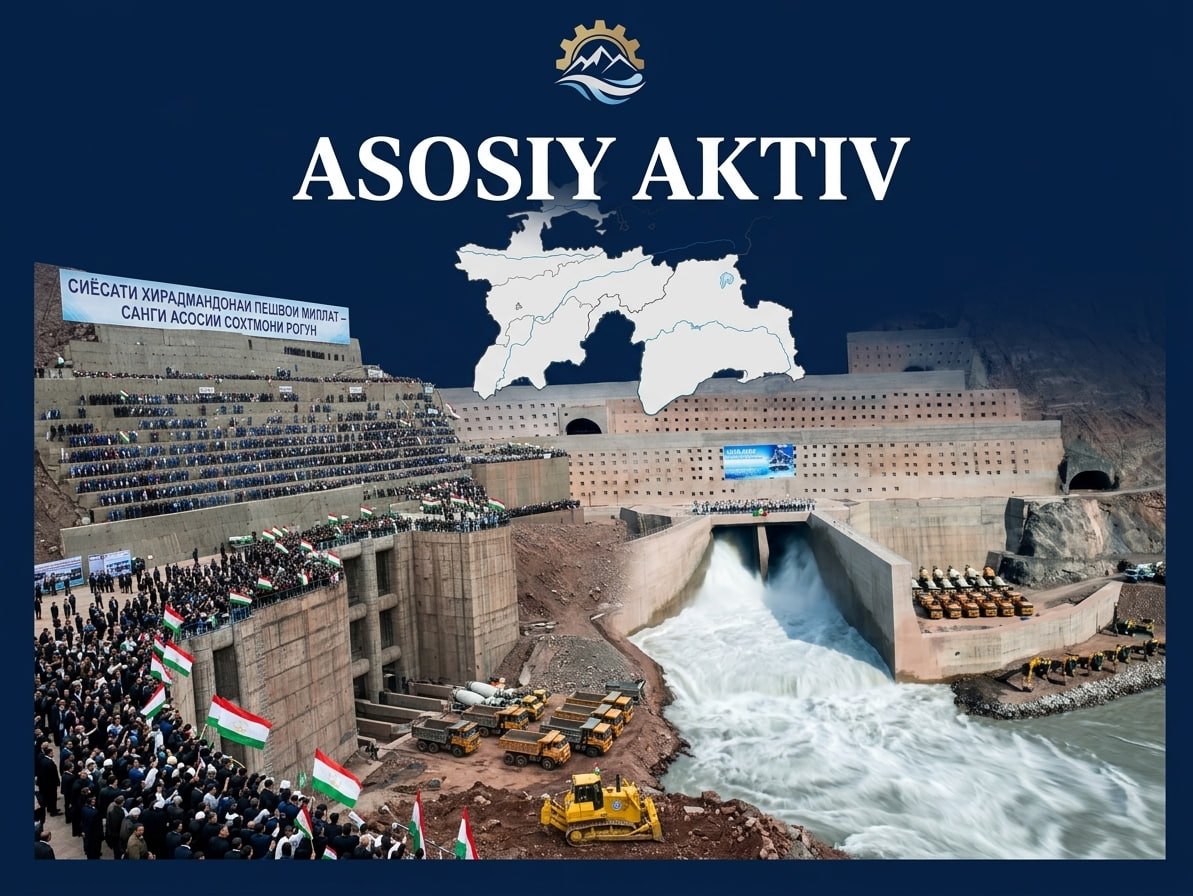
The complete finalization of the Rogun HPP—a hydropower giant featuring a record-breaking 335-meter dam—will require at least another $5.8 billion. This colossal financial deficit transforms the Tajik mega-project into Central Asia's largest investment testing ground, the development of which directly depends on international creditors, climate funds, and transnational geopolitical interests.
The massive project, which for years served as the primary trigger for interstate conflicts in the region over water resource distribution, has today transformed into an instrument of global financial influence. Middle Eastern investments, Western institutional grants, and Tashkent's new pragmatic contracts forge a macroeconomic reality where control over transboundary infrastructure dictates the rules of the game for all regional trade.
Tectonic Risks and Engineering Challenges
The engineering complexity of the mega-dam is exacerbated by extreme conditions in the Pamir highlands. The structure is being built on the Vakhsh River, forming a critical link in the river's cascade system. Following years of freezing due to political and economic instability, the active phase of construction was restarted to address chronic energy shortages. At peak moments, the site mobilizes an unprecedented labor and technical resource. However, these ambitious construction paces consistently collide with harsh geological realities and severe financial constraints.
From Political Veto to Pragmatic Contracts
A key barrier to the project's realization over a quarter of a century was the water dispute. The construction of a giant reservoir on the Vakhsh—one of the main tributaries of the Amu Darya—raised well-founded concerns regarding water availability for downstream irrigation.Today, the architecture of regional relations has radically shifted toward economic pragmatism. Tashkent now acts not as an opponent, but as a major institutional buyer. According to the approved agreement, Uzbekistan will import Tajik electricity from the Rogun HPP at a fixed tariff of 3.4 cents per 1 kWh. The supply scheme is strictly tied to the agricultural cycle. During the construction phase, exports will be carried out exclusively during the vegetation period—from April to September. Once the station reaches its full design capacity, deliveries will transition to a year-round, monthly schedule.
The Debt Spiral and International Syndicate
The hydropower plant's financial model demonstrates an unprecedented growth in debt burden. While the estimated baseline cost stands at $6 billion, completing the facility will require further multibillion-dollar injections. The financial bloc acknowledges that inflation, rising material costs, and complex geology constantly alter the final estimates. Currently, primary capitalization is secured through a consortium of 12 international development partners. The World Bank has approved a $300 million allocation specifically for the second phase of construction. These funds are strictly conditioned by social requirements, focusing on the resettlement of households and the restoration of local population incomes. Western capital is supplemented by European state participation. Italy, through the state bank Cassa Depositi e Prestiti (CDP), is allocating $150 million for the project's co-financing. Simultaneously, control over the region's debt obligations is being aggressively seized by Middle Eastern capital. The Islamic Development Bank and Arab funds are cumulatively investing $550 million into the project. This financial syndicate directly includes the Abu Dhabi Fund for Development with a $100 million commitment, the government of Qatar allocating $50 million, and the Kuwait Fund for Arab Economic Development, which recently signed a $16.7 million credit agreement as part of a larger $100 million financing package.
Energy Expansion and Transit Prospects
From a technical standpoint, the Rogun HPP is designed to reach a total capacity of 3600 - 3780 MW. This massive infrastructure will allow the generation of over 13.1 billion kWh of electricity annually. The first steps have already been taken: the first unit of 360 MW was launched on November 16, 2018, and a second 400 MW unit followed on September 9, 2019. The completion of the facility will not only minimize chronic winter energy deficits within Tajikistan but also create a foundation for new integration processes. However, execution timelines remain fluid. Bringing the largest energy facility to full capacity is expected no earlier than 2028. By the time of a full launch, transit states and industrial consumers will face a new market architecture, where accumulated multibillion-dollar debt obligations to the pool of Arab funds and Western institutions will become the primary factor dictating pricing and transit policy across the Eurasian space.