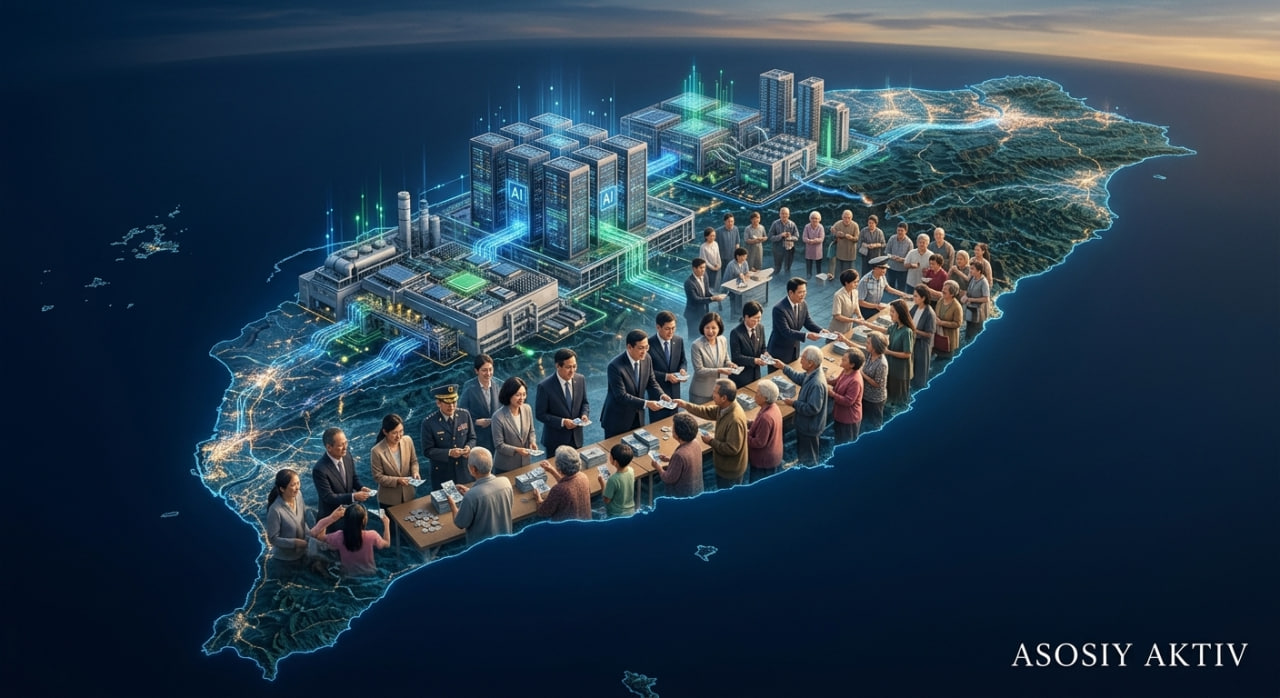
The Taiwanese government has officially announced an unprecedented distribution of funds, handing out 10,000 New Taiwan Dollars ($314) to every citizen, financed directly by revenues from the artificial intelligence (AI) boom. This massive $7.4 billion financial injection is being executed against the backdrop of the island’s expected 11% GDP growth in 2026 and semiconductor exports projected to hit a staggering $903 billion.
This macroeconomic maneuver carries a significance far deeper than the populist distribution of a budget surplus. It represents the first physical implementation in the real economy of technological rent and the universal basic income (UBI) mechanism—a scenario that tech hegemons like Tesla CEO Elon Musk, OpenAI CEO Sam Altman, and Nobel laureate Geoffrey Hinton have explicitly warned about for years.
Corporate Lock-ins and U.S. Lobbying
While the United States remains the absolute center of AI software and intellectual property, its financial architecture strictly prohibits such a distribution. The trillions of dollars in value generated by corporations like Nvidia, Microsoft, and OpenAI are locked up in stock buybacks and corporate treasury accounts. Powerful technological lobbying aggressively blocks any attempts to legislate a "robot tax" or implement direct wealth redistribution mechanisms.
Taiwan, conversely, holds a physical monopoly through the hardware heart of global AI infrastructure—manufacturers like TSMC. Export-oriented manufacturing is tightly monitored and easily taxed by the state. Amid relentless geopolitical risks, the government views the tech sector as a core matter of national security. By directly distributing AI rent, the state is artificially cementing social cohesion between the high-tech industry and the public, effectively purchasing loyalty.
Central Asia’s Technological and Institutional Abyss
The probability of distributing such "technological dividends" in Uzbekistan and the broader Central Asian region in the coming decades is mathematically and institutionally zero. Countries in this region sit at the absolute bottom of the global economic value chain, functioning primarily as exporters of raw materials and cheap labor. To distribute AI rent, a state must first domestically harbor the intellectual property or global infrastructure that generates the revenue.
Central Asian states are merely consumers of ready-made foreign AI services, a dynamic that guarantees domestic capital only flows outward. Furthermore, given the region's institutional weakness, even super-profits extracted from traditional natural resources fail to reach citizens as direct dividends. Developing nations are currently absorbed in mitigating basic macroeconomic and energy deficits, rather than stockpiling capital to compensate for jobs slated for automated eradication.
Social Tranquilizers and the Trade of Consent
Taiwan’s total $7.4 billion payout functions as an advance payment ahead of a looming economic crisis and class discontent. The relentless advancement of AI will inevitably trigger a massive contraction in the white-collar labor market, decimating roles for programmers, analysts, and finance professionals. The question of who will purchase corporate products if consumers lose their monthly salaries is rapidly morphing into the foundational crisis of modern capitalism.
Paying dividends to citizens operates as a pacification strategy engineered by governments and tech hegemons. The objective is to mask the stripping away of the population's labor and social functions while preventing mass radicalization. Taiwan is offering a new-generation social contract: algorithms will replace human labor, but technology will provide the minimum capital required for baseline survival.
Whether this Taiwanese experiment evolves into a permanent, guaranteed universal basic income or merely serves as a cheap political tranquilizer to mask humanity's plunge into technological unemployment will be determined by the velocity of the global labor market's structural collapse in the coming quarters.