Strategic shifts are unfolding in the precious metals market, which forms the absolute core of the Central Bank's foreign exchange reserves. The government is preparing to sell record assets at optimal prices and engage directly with American money managers.
Central banks purchased 23 tons of pure gold on the international market in July. Total purchases since the beginning of the year amounted to 130 tons. Despite a decline compared to the 160 tons recorded during the same period last year, nations are aggressively reallocating their assets to diversify global reserves and hedge against geopolitical risks.
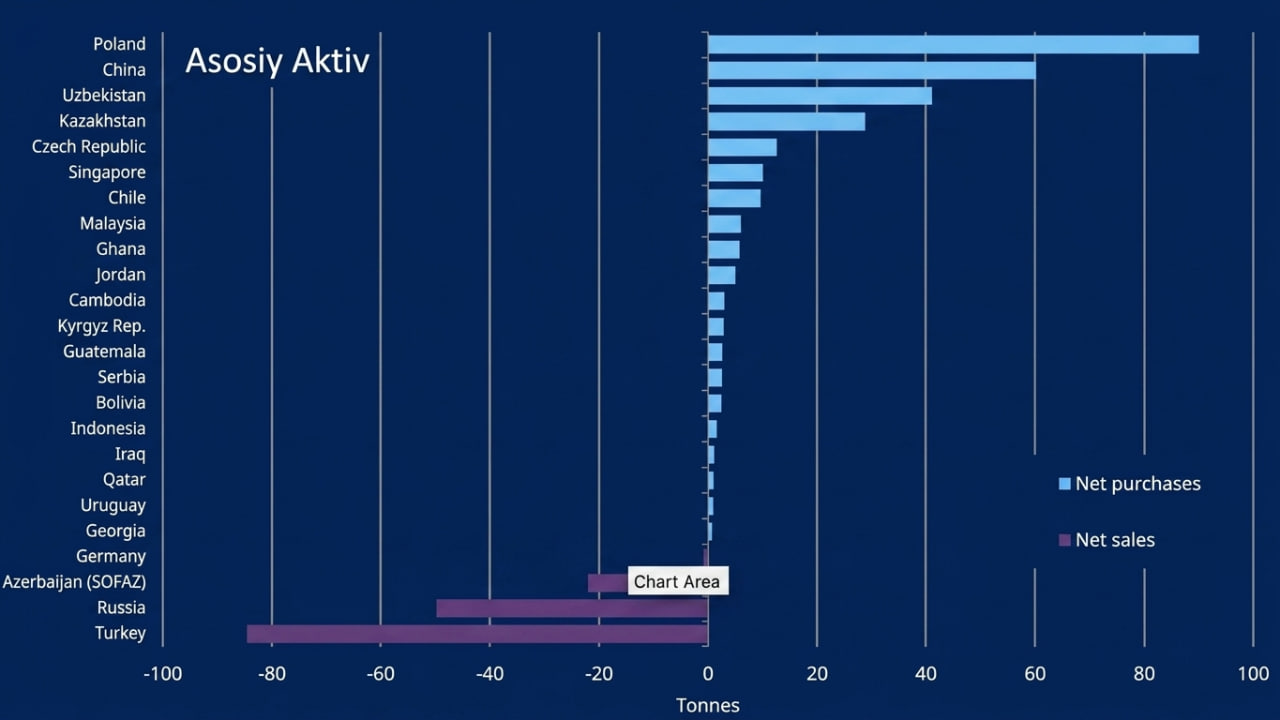
Against this volatile backdrop, the Central Bank of Uzbekistan is sharply modernizing its financial policy. In July, the country sold 1 ton of gold on the international market, while total purchases since the beginning of the year reached 40 tons. Currently, the country's total gold reserves stand at 431 tons, which equals exactly 87 percent of the state's total foreign exchange reserves. Central Bank Governor Timur Ishmetov's active engagement with American money managers has caused strong resonance in the market. He stated that while gold has been the best investment tool so far, the bank is now looking for opportunities to sell the precious metal at the most favorable and highest prices as part of its overall reserve management strategy.
The activity of central banks in the international market is forming entirely new trends. Some nations are accumulating assets at an unprecedented pace, while others are leveraging high market prices to lock in cash profits:
The National Bank of Poland is not halting its aggressive purchasing streak. Since the beginning of the year, the country has bought the most, acquiring 90 tons of gold and bringing its total reserves to 640 tons. The government is very close to its strategic target of 700 tons.
The People's Bank of China continued its twenty one month buying cycle, adding another 20 tons to its reserves in July alone. Having purchased 60 tons since the beginning of the year, China's total gold reserves reached 2366 tons, climbing to sixth place globally. Even though gold accounts for only 8 percent of total reserves, the monthly purchases measured in double digits are becoming a major driver for price growth in the global financial market.
Kazakhstan purchased 29 tons of gold since the beginning of the year, securing its spot among the top five largest buyers globally. The share of the precious metal in their total reserves has risen to 75 percent.
The Central Bank of Russia continues to offload its gold assets, maintaining a net seller position. An additional 6 tons of metal were sold in July, and the total sales volume this year reached 50 tons, shrinking total reserves to 2277 tons.
A similar trend is observed in Turkey, where 1 ton was sold in July, and a total of 85 tons of gold has been sold since the beginning of the year, injecting a large volume of liquidity into the market.
Major economies across other continents are also rushing to protect their reserves amidst an uncertain macroeconomic climate. The Bank of Korea announced the purchase of 250 million dollars worth of locally refined gold, equating to 2 tons, for the first time in thirteen years to hedge against inflation risks. The Venezuelan government has initiated aggressive international negotiations to repatriate 4 billion dollars in gold reserves, frozen for years in the Bank of England, to rebuild the country's infrastructure. Namibia has signed direct strategic purchasing agreements with local mining companies with the intention of tripling its gold reserves. The steady growth in the price of the precious metal offers major asset holders like Uzbekistan an unprecedented financial advantage in international trading and executing multi billion dollar commercial operations.