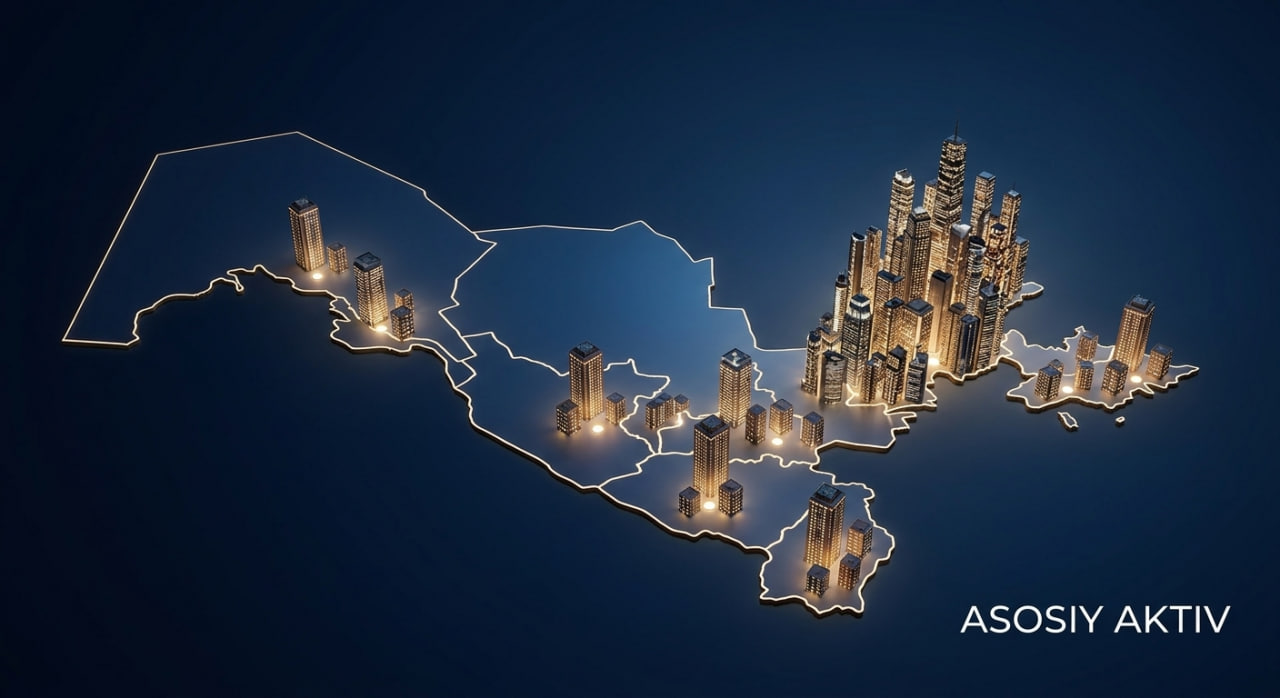
Statistical figures often expose the bitter truth about a country's economic health. Out of the 227.4 trillion UZS spent on construction in the first half of the year, a staggering 76.2 trillion UZS—more than a third of the national total—was concentrated solely in Tashkent. Combined with the Tashkent region (21.1 trillion UZS), this accounts for nearly half of the entire sector. This alarming disproportion highlights the severe economic pains caused by centralizing capital exclusively in the metropolis.
Concentrating investments in a single region triggers a profound territorial divide. Regions such as Syrdarya (4.7 trillion UZS), Jizzakh (5.5 trillion UZS), and Karakalpakstan (7.8 trillion UZS) are lagging 10 to 15 times behind the capital. This powerful magnetic pull turns the provinces into donors, constantly draining their human and financial resources to feed the capital's growth.
The first major blow from funneling capital into the capital’s construction sector is massive demographic and infrastructural pressure. The absence of major construction projects and new production facilities in the regions forces the national workforce to migrate to Tashkent. Low investment appeal in densely populated areas like Fergana (13.8 trillion UZS) and Kashkadarya (11.1 trillion UZS) pushes internal migration to abnormal levels. Consequently, the capital’s transport, utility, and social infrastructures buckle under the pressure, while real estate and rental prices reach astronomical heights.
The second core issue is the stagnation of the real economy. Construction provides a short-term economic overheat rather than sustainable, value-added growth. Instead of funding innovative factories, high-tech clusters, or agricultural modernization, hundreds of trillions of sums in Tashkent are being poured into skyscrapers and shopping malls. Regions like Khorezm (10.3 trillion UZS) desperately need these financial injections to develop local industries. Without spreading investments across the country, national export potential stagnates, creating a closed-loop economy that merely circulates budget funds within the capital.
The most dangerous consequence of this trend is the expansion of the shadow economy and rising social tension. In rapidly growing regions like Surkhandarya (9.9 trillion UZS) and Namangan (10.0 trillion UZS), a critical lack of job-creating investments drives a massive portion of the population into the informal sector or labor migration. Provincial budget revenues drop, leaving these regions entirely dependent on central subsidies. While the capital is flooded with investment, the financial starvation of the regions creates a deep economic and social divide.
Funneling an enormous 76 trillion UZS purely into the capital's construction sector is a flawed national development strategy. Unless investments are actively redirected from Tashkent’s skyline toward the real economy, production, and job creation in the provinces, the country risks ending up with one glittering megacity casting a dark shadow over dozens of struggling regions.