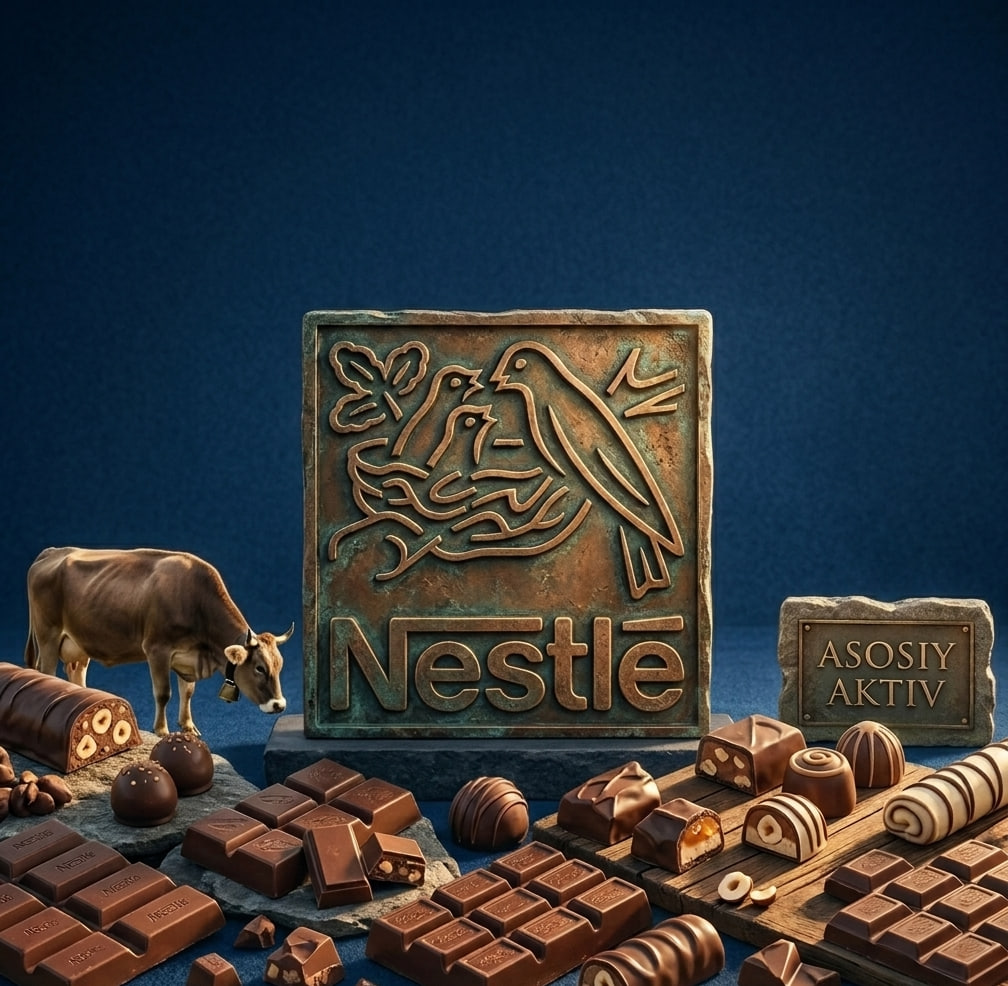
Despite being a proudly Swiss enterprise, a staggering 99 percent of its revenue is systematically extracted from foreign markets. Through highly lucrative wartime government contracts, aggressive multi-billion-dollar corporate buyouts, and a ruthlessly profitable closed-loop coffee monopoly, Nestlé has engineered itself into the ultimate apex predator of the global stock market.
In the upper echelons of global finance, the rules are governed entirely by numbers, and the numbers are absolute. By the end of 2023, Nestlé reported a jaw-dropping revenue of 92 billion 998 million Swiss francs. Yet the most provocative and revealing metric is that a mere 1.18 percent of this colossal cash mass originates from its home country of Switzerland. The remaining 99 percent of its capital is continuously siphoned from 188 countries across the globe. This entity long ago transcended the definition of a traditional multinational food and beverage corporation, mutating into a borderless cash-generating machine with its own macroeconomic gravity.
Digging deep into the corporate archives reveals that this empire was actually seeded by a straightforward humanitarian initiative. In 1867, German-born pharmacist Henri Nestlé formulated a milk-based baby food to combat staggering infant mortality rates. However, the real influx of capital and the genesis of modern corporate scale occurred during periods of global devastation. While the international economy fractured under the weight of World War I and World War II, the Nestlé boardroom maneuvered to secure massive government defense contracts, supplying frontline military forces with endless shipments of condensed milk and Nescafé instant coffee. These guaranteed, high-volume government deals supercharged their manufacturing capacity, generated unprecedented net profits, and built the massive cash reserves required to fund their future global conquest.
The core growth strategy crafted by Nestlé executives has rarely relied on brutal, margin-crushing price wars. Instead, they simply buy out the competition with overwhelming liquid capital. Roughly two-thirds of the corporation's historical growth is directly attributed to aggressive corporate takeovers disguised as friendly mergers. In 1947, acquiring Maggi allowed them to corner the seasoning market. In 1988, they deployed 4 billion 500 million dollars to swallow the British confectionery giant Rowntree Mackintosh, absorbing the hyper-profitable KitKat brand into their portfolio. But their financial appetite extended far beyond mere food production. Sensing the astronomical profit margins of the beauty industry in 1974, Nestlé acquired a massive stake in the French cosmetics titan L'Oreal. This calculated strategic pivot allowed them to diversify their balance sheet, effectively hedging against any volatility in the agricultural commodities market and stabilizing their share price for Wall Street investors.
Over the subsequent decades, the corporation sharpened its predatory instincts. It monopolized the premium bottled water sector by swallowing France's Perrier in 1992 and Italy's San Pellegrino in 1998. Foreseeing the explosive financial future of the pet care market in 2001, Nestlé acquired the Purina brand, unlocking a brand-new multi-billion-dollar revenue stream. To permanently cement an absolute monopoly over global infant nutrition, the corporation deployed 5 billion 500 million dollars for America's Gerber in 2007, followed by a staggering 11 billion 900 million dollar payout for Pfizer's nutrition division in 2012. The numbers clearly dictate that Nestlé possesses the sheer financial brute force to obliterate any potential market rival. Even the dominant coffee empire Starbucks was forced to compromise with this financial leviathan. In a landmark 2018 deal worth 7 billion 150 million dollars, Nestlé outright purchased the exclusive global rights to distribute and profit from Starbucks packaged coffee products.
Yet, the most brilliantly engineered and profoundly profitable financial mechanism in Nestlé's history remains the Nespresso closed-loop capsule system. Launched into the market in 1986, this was never merely a technological innovation, it was the flawless execution of the razor-and-blades business model. Consumers purchase a relatively affordable coffee machine, only to find themselves permanently locked into buying expensive, proprietary coffee capsules sold exclusively through corporate-controlled channels. This masterclass in financial engineering guaranteed the company a stable, recurring revenue stream with astronomically high profit margins. Nespresso ceased to be just a beverage, becoming a highly efficient asset designed to permanently tether the consumer's wallet to the corporation's balance sheet.
Today, Nestlé controls global commerce through a meticulously balanced management model, combining strictly centralized strategic capital allocation with ruthless localized operational execution. While the Swiss headquarters dictates long-term multi-billion-dollar investments, its 340 factories spread across 76 countries operate with a singular focus on slashing logistics costs and maximizing localized profit margins. Their localization strategy is less about cultural respect and entirely about depressing supply chain costs by utilizing cheaper domestic raw materials. Nestlé is no longer just a food manufacturer. It is a perfected capitalist apparatus built on calculated strategic investments, the exploitation of wartime crises, and the creation of consumer consumption models that transform everyday buyers into perpetual financial donors.