Currently, $15.6 trillion circulating within global financial markets is directly tethered to a single algorithm: the S&P 500 index. S&P Global maintains over 1 million active credit ratings across corporate, banking, and sovereign debt, granting the institution absolute authority to dictate the direction of capital flows and baseline global interest rates.
The explosion of passive investment strategies and algorithmic trading architectures has transfigured this data provider into the central nervous system of Wall Street. While central banks and titan private funds previously orchestrated capital distribution, this function is now exclusively delegated to the index rebalancings and credit decisions of one entity. S&P’s verdicts immediately unlock institutional liquidity or permanently exile companies from the capital markets.
Origins: From Railroads to Financial Markets
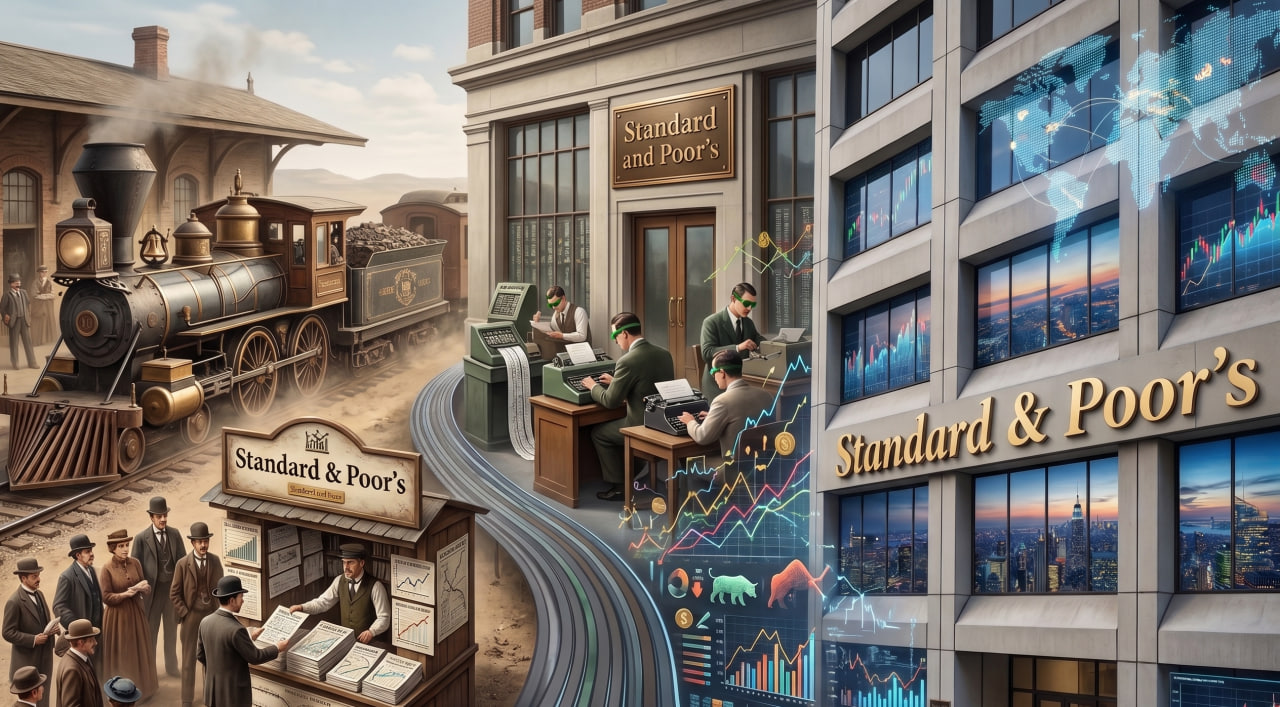
The lineage of this $150 billion market-cap empire traces back to 1860, originating with a simple manual titled "History of the Railroads and Canals of the United States" authored by Henry Varnum Poor. At the time, European investors were injecting massive capital into American infrastructure blindly, devoid of actual corporate financial health metrics. Poor introduced transparency, effectively pioneering the financial data industry.
Half a century later in 1906, entrepreneur Luther Lee Blake founded the Standard Statistics Bureau. His operational innovation replaced bulky books with frequently updated 5x7-inch cards. This radically accelerated information delivery, making it an indispensable tool for traders. By 1923, this bureau engineered the first U.S. stock market indicator, tracking 233 companies.
The Merger and the Paradigm Shift
Surviving the Great Depression, the two publishing houses merged in 1941 to forge the historic Standard & Poor's brand. In 1957, the firm launched its paramount product: the daily, computer-generated S&P 500 index, which became the definitive barometer of the American economy. A 1966 acquisition by publishing giant McGraw-Hill armed the corporation with the capital necessary for aggressive international expansion.
The foundational shift in the business model occurred in the 1970s. S&P pivoted from an investor-pays model to an "issuer-pays" architecture. Corporations and sovereigns became contractually obligated to pay for their own creditworthiness assessments prior to accessing debt markets. This structural flip triggered explosive revenue growth and calcified the rating industry into a closed oligopoly.
Service Portfolio: The Trillion-Dollar Price of Data
Today, S&P Global operates through four ultra-high-margin divisions. S&P Global Ratings commands roughly half of all global debt issuances, assigning grades from a pristine AAA down to a defaulting D, alongside specialized SPURs ratings for municipalities. The S&P Dow Jones Indices division licenses thousands of benchmarks, anchoring the Dow Jones Industrial Average and the S&P MidCap 400.
The Market Intelligence division commands Capital IQ—Wall Street’s premier analytical terminal, aggregating granular financial data on nearly every public and private company globally. The fourth pillar, Platts, establishes the definitive benchmark pricing for global commodities, including oil, gas, and metals. Physical crude transactions in the Middle East are directly indexed to Platts' published quotations.
The "Tax" on Capital Access and Pricing
The cost of S&P’s services operates as a mandatory tax for market access. Securing a single credit rating for a corporate bond issuance strips the issuer of 4 to 5 basis points of the total offering size, frequently translating to hundreds of thousands of dollars. For complex syndicated loans, the invoice can reach $500,000. Institutional asset managers are strictly prohibited by their own mandates from acquiring unrated paper without S&P, Moody’s, or Fitch approval.
An annual seat on the Capital IQ terminal costs a financial analyst between $15,000 and $25,000. Index revenue scales entirely differently: ETF titans like BlackRock and Vanguard remit a fixed percentage of their total assets under management (AUM) directly to S&P merely to license the S&P 500 trademark.
The IHS Markit Megadeal and Unmatched Hegemony
In 2022, S&P Global closed the largest transaction in the history of financial data, absorbing British firm IHS Markit for $44 billion. This acquisition granted the conglomerate absolute dominance in fixed-income indices and automotive supply chain analytics (the Mobility division). S&P now monitors not just equities and debt, but the physical pricing of the global supply chain.
Client Base and the Ownership Paradox
The company services over 100,000 institutional clients, explicitly including 100% of the Fortune 500. Yet, the ultimate market paradox lies in its shareholder registry. The largest owners of this NYSE-traded monopoly (ticker: SPGI) are Vanguard (8.9%), BlackRock (7.6%), and State Street (4.5%). The exact institutions generating the vast majority of S&P’s index and data revenue are its ultimate beneficiaries.